
June 2, 2026
Why Self-Serve Content is Eating the Traditional B2B Funnel Alive
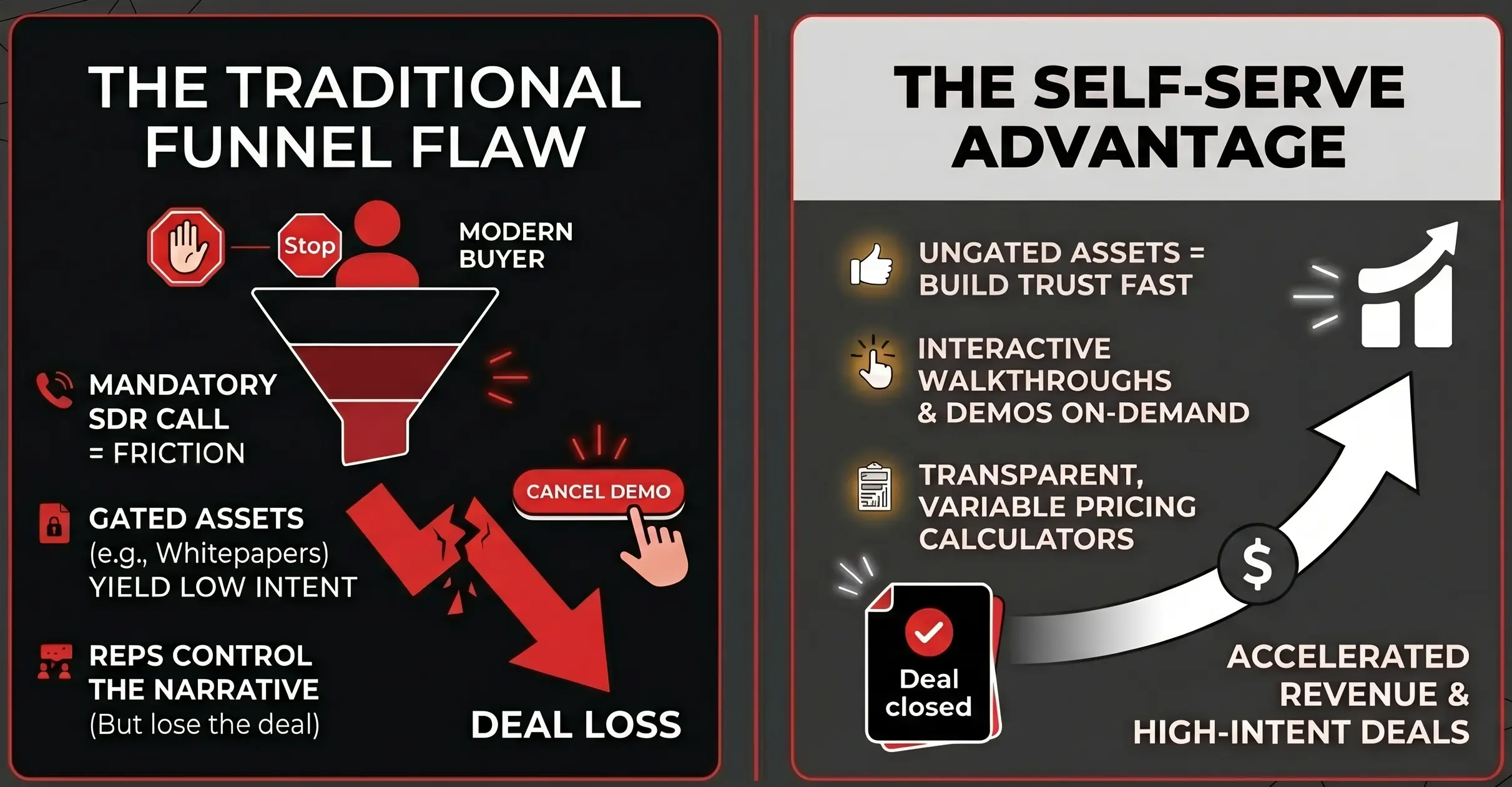
The modern B2B buyer isn't lazy; they are protective of their time. The traditional sales funnel—where a prospect downloads a gated whitepaper, gets hounded by an SDR, and must sit through a 30-minute qualification call just to see a product screenshot—is hemorrhaging revenue.

Damien
DESIGN. IDENTITY. SCALE.
When you hide your product, pricing, and technical documentation behind a mandatory sales wall, you aren’t creating exclusivity. You are creating friction. Software buyers, procurement officers, and operations executives are doing up to 80% of their research before they ever talk to a representative. If your website forces them to jump through hoops to understand your value proposition, they will simply open a tab for a competitor who doesn’t make them work for it.
The friction point lies in an outdated belief: that sales reps control the narrative. They don’t. High-intent buyers want to self-educate, validate use cases, and calculate ROI on their own terms. Forcing a high-pressure sales call early in the journey filters out your most sophisticated, high-value prospects, leaving you with a pipeline full of low-intent tire-kickers who have nothing but time to waste on Zoom.
The Frictionless Architecture: Engineering an Asynchronous Content Engine That Sells 24/7
To capture the modern B2B buyer, your website must shift from a digital brochure to an interactive, self-serve validation engine. This requires a complete re-engineering of your information architecture, content assets, and conversion triggers.
Step 1: Open the Gates on Core Assets
Stop gating your best insights. Gating an e-book or a case study behind a lead form for a fake email address ($123@gmail.com$) yields zero actual business value. It just inflates your MQL metrics with garbage data.
- Ungate Everything Asset-Based: Whitepapers, case studies, and technical specifications must be entirely open-access.
- The Content Hierarchy: Use a modular layout where a visitor can skim a high-level summary, click to expand deep-dive technical data, or copy a code snippet directly from the page.
Step 2: Implement Interactive Product Walkthroughs
If a prospect cannot see how your solution works within 60 seconds of landing on your site, you have lost them. Static screenshots do not cut it anymore. Use interactive, embedded product tours (via tools like Navattic or Arcade) or ungated, high-fidelity video walkthroughs.
- The 3-Tier Video Strategy:
- The 90-Second Hook: High-level overview of the exact pain point solved, prominently displayed above the fold.
- The 5-Minute Modular Deep-Dive: A clickable playlist broken down by feature set or user persona (e.g., “For Engineering Leaders,” “For Compliance Officers”).
- The Click-Through Sandbox: An embedded, clickable mock environment where users can click buttons, view dashboards, and experience the UI firsthand.
Step 3: Transparent, Variable Pricing Matrix
The phrase “Contact Us for Pricing” is a conversion killer for companies with less than 5,000 employees. Buyers assume that a hidden price tag means you are either wildly expensive or making up numbers on the fly based on their company’s revenue.
| Tier / Segment | Infrastructure Access | Support Level | Pricing Model |
| Growth | Single instance, API limits capped at 50k/mo | Documentation + Shared Slack | Transparent monthly/annual flat rate |
| Scale | Multi-region deployment, API limits up to 500k/mo | Dedicated Slack + 4-hour SLA | Tiered consumption or seat-based model |
| Enterprise | Custom architecture, dedicated VPC, unlimited API | 24/7 Phone + Named Account Engineer | Custom quote (with clear baseline parameters) |
Even if your product requires complex, enterprise-level scoping, you must provide a baseline calculator. Give them a tool where they can input their volume, user seats, or data requirements and receive an immediate, realistic estimate.
Step 4: The Reverse-Funnel Conversion Infrastructure
When you remove the mandatory demo call, your conversion mechanisms must adapt. Instead of forcing a call, offer multiple avenues of intent validation.
- Primary Call to Action (CTA): “Start Free Trial” or “Launch Interactive Sandbox.”
- Secondary CTA: “Talk to a Technical Architect” (positioned for complex deployments, completely bypassing traditional SDR gatekeepers).
- Asynchronous Booking: Integrate scheduling tools directly onto product validation pages, allowing users to book a call only after they have consumed specific, high-value content blocks.
The Dark-Funnel Leverage: Weaponizing Public Utilities for Hidden Attribution
The ultimate competitive advantage in a self-serve ecosystem is capturing demand that occurs where traditional tracking scripts cannot look. Most B2B marketers focus entirely on direct software metrics—clicks, form fills, and cookie-based attribution. The elite 1% optimize for the “Dark Funnel”: peer recommendations, private Slack communities, Reddit threads, and internal corporate memes.
Contrarian Take: The most valuable content your company can produce should be designed to be screenshotted and shared inside a private corporate Slack channel without a link.
If your content requires a user to copy a tracked URL with a massive UTM string to share an insight with their VP, it won’t happen. Instead, build highly shareable, unbranded, high-utility tools and assets that solve a highly specific technical problem.
The Tool-As-Content Strategy
Instead of writing another 2,000-word blog post on “Why SEO matters,” build a free, ungated, server-side log analyzer or an ROI calculator that runs entirely in the browser.
- Do not ask for an email to show the results.
- Give them the raw data immediately.
- Include a single, clean button: “Export PDF Report for Your Executive Board.”
When that PDF lands on the desk of a C-level executive, your branding is baked into a tool that just saved their engineering team 10 hours of manual work. You didn’t capture their email on page one, but you captured the entire account’s trust. When they finally do reach out via your contact page, their first message won’t be “Tell me what you do.” It will be “We used your tool, validated our gap, and we want to buy the enterprise version to fix it automatically.”